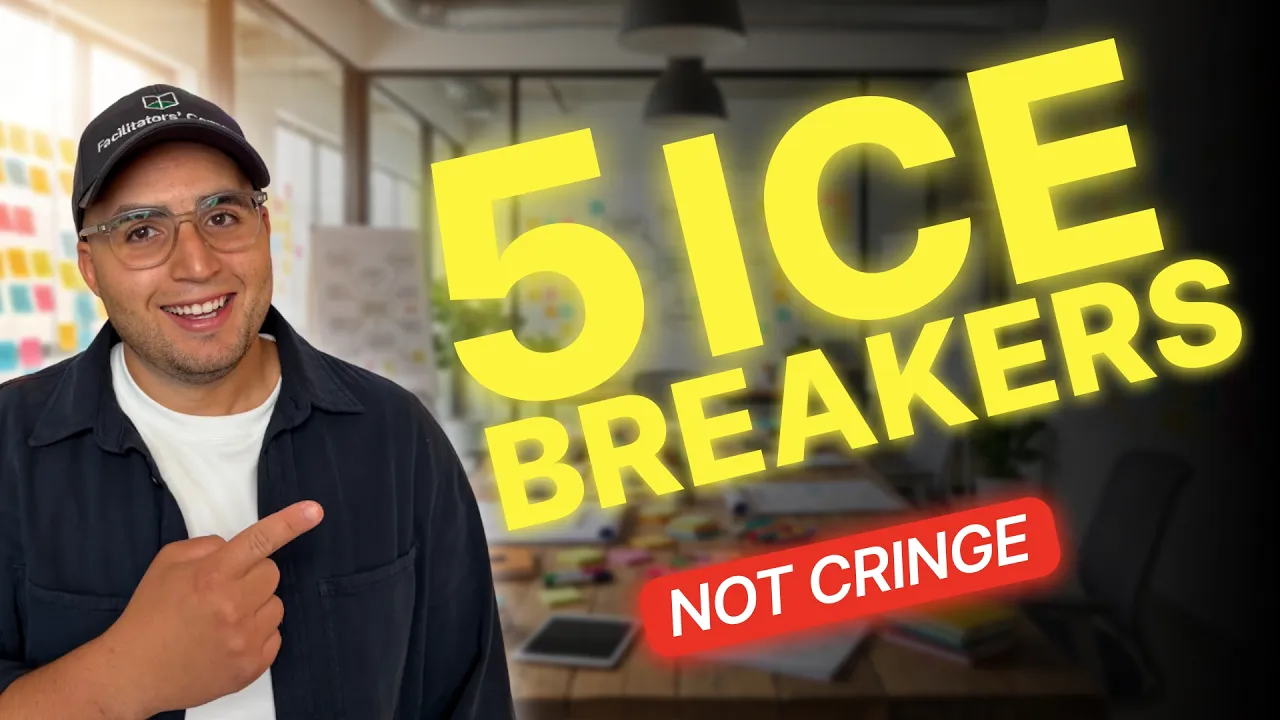
5 icebreakers that aren't cringe
Why most icebreakers make a room want to disappear, and the five I use in every kind of session.

Mehdi En-Naizi29 Sept 2026 · 3 min read
Say the word “icebreaker” in a room and you can feel it. Everyone thinks the same thing. Oh no, this is going to be cringe.
I get it. I used to hate them too. I sat through enough compulsory trainings where the facilitator pulled out some weird activity and I just wanted it to be over. So when I started facilitating, I skipped them completely.
Then COVID happened.
My sessions went remote, people were alone at home, and the groups felt disconnected. I gave icebreakers one more chance. The impact on the sessions was so big, on the mood and on the quality of what people produced, that I’ve never removed them since.
I’ve put my five favourite warm-ups in a free guide, with the written instructions and the Miro templates. Leave your email here and I’ll send it straight to your inbox.
Free icebreaker guide
The 5 icebreakers from this post, with step-by-step instructions and ready-to-use Miro templates.
Free. No fluff, no spam, you can unsubscribe anytime.
So why are so many icebreakers cringe?
After hundreds of workshops, I think it comes down to two things.
First, most icebreakers turn connection into competition.
“Share a fun fact.” “Tell us something surprising about you.”
People go into their heads, stressed, trying to find a story they don’t have. They’re not listening to anyone else. They’re just waiting for their turn to perform.
Second, the facilitator doesn’t sell it. If the activity feels like a box to tick on your checklist, the group feels it.
Think of a comedian. If he doesn’t sell the joke well, nobody will laugh, even if it’s funny.
Here’s the short version:
My 5 favourite icebreakers
In this episode of Another Day, Another Workshop, I share the ones I use without a second thought in my team retreats, problem-solving workshops, and even trainings. They always deliver.
Two of them are purely about connection.
Time Traveler. Everyone opens the photo app on their phone, scrolls back to the first picture they ever took with it, and tells the story behind it. No pressure to be funny. The story is already there, and people relive a good memory while they share it.
Curiosity Exchange. Participants write two or three questions they’d really like to ask the people in the room. Then, in pairs, they answer their own question. Not the other person’s. That twist means everyone chooses how much they want to share.
The other three will help you do a better job as a facilitator.
Why It Matters. Each person answers two questions: why does this topic matter to me, and why does it matter to the team? The purpose comes from them, not from you. Very effective in change or transformation contexts.
Hopes and Fears. The classic, and still the best way I know to collect expectations and manage them fast. Most disappointment after a workshop comes from expectations that were never said out loud.
Zombie Apocalypse. You’re in a huge store, zombies arrive in ten minutes, pick three items as a group to survive. It’s fun, but watch what happens: someone tries to convince everyone, someone stays quiet, someone checks their phone. That’s every meeting ever. It’s the perfect setup to introduce your collaboration rules right after.
Ready to run them?
Get all five in one free guide, with the instructions and Miro templates, so you can use them in your next session.
Free. No fluff, no spam, you can unsubscribe anytime.
Watch or listen to the full episode
The full episode is on YouTube, Spotify and Apple Podcasts.
So, which one will you try first?
P.S. If you enjoy these activities, they come from the Workshop Deck. The light blue cards, the Connection ones. A new activity lands on theworkshopdeck.com/resources every week.
7 day free trial
Workshop Deck
If two hours still sounds impossible, this is the fastest way to see why I think it is not.
Start the trial →Brussels · 18–19 MarchWorkshop Design Masterclass
Two days, ten people. On day two you design a complete workshop live, from a real client brief.
See the masterclass →Did you like this article?
Join the newsletter and get practical tips like these every week.
We'll only email you when we have something important to share. No spam, ever.
P.S. If two hours sounds impossible, it is usually not a speed problem. It is a blank page problem. That is the whole reason the Workshop Deck exists, so you are never starting from nothing.
See you in the corner.
Mehdi