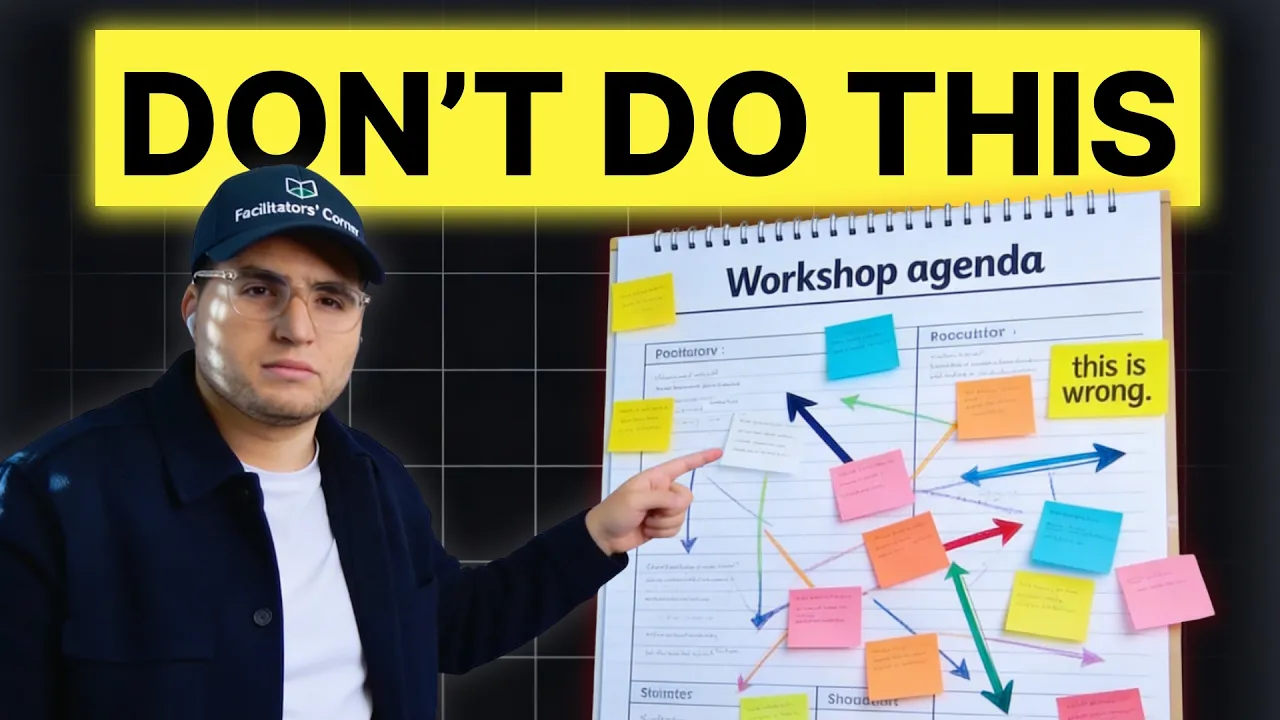
Why Clients Don’t Come Back After Your Workshop
The hard lessons I learned after screwing up sessions and watching clients never come back.

Mehdi En-Naizi14 Aug 2026 · 8 min read
Hey Facilitator Friend,
Let’s do something fun today. Well, fun for you. Maybe a little painful for me. 😅
Today we’re talking about the mistakes that cost me real clients.
Not the cute little “oops, I forgot the voting dots.” I mean the expensive ones. The ones that hurt the session, hurt your confidence, and sometimes guarantee the client never calls you back.
I’ve been facilitating workshops for 6 years. And I’ve made most of these mistakes at least once. Some before I even walked into the room. Some live, in front of a group, while holding a marker and doing my best poker face.
So here’s how I organized them, by when they happen to you:
5 mistakes in preparation. 5 mistakes in the room. 1 bonus mistake that too many facilitators still make.
Let’s get into it.
Part 1: The mistakes that happen before the workshop even starts
1. Not daring to say no to the client
This is probably the most expensive mistake of all.
A client finally commits to investing half a day or a full day in a workshop. And of course, they show up with a wishlist longer than a Christmas letter.
Dear Santa, what I want for Christmas is: alignment, clarity, ideas, decisions, an action plan, better communication… and maybe world peace while you’re at it.
And if you say yes to all of that? You’re already in trouble.
Because you’re not Santa. Your job is not to please the wishlist. Your job is to protect the outcome.
That means asking enough questions to understand what actually matters. That means reducing scope. That means saying: “We cannot do all of this in one session.”
And honestly? Saying no is part of what makes you credible.
One thing I do now: I separate goals into two buckets. The minimum goals, the ones I fully commit to. And the “cherry on the cake” goals, the nice extras if time allows. That way, I protect the experience. And if we go further, it feels like overdelivery.

2. Overloading the workshop with too many activities

We all love a rich agenda.
An energizer here. A creative exercise there. A reflection moment. A framework from Miroverse. Another one because it looked good in the template.
The problem? Every activity costs time. And every explanation costs mental energy.
The more activities you pack in, the less time participants have to actually think, contribute, and build on each other’s ideas. Your agenda might look impressive on paper. But in the room, it can feel rushed, fragmented, and shallow.
You want enough activities to create rhythm. Not so many that people spend the whole day just trying to understand what they’re supposed to do next.
3. Making the workshop too complicated

This one is close to the previous, but even more dangerous.
Sometimes you find an activity that looks brilliant. Beautiful diagram. Clever framework. Elegant output. And then you try it in a real workshop and people get lost after step two.
The more complex the activity, the bigger the risk. Risk that people misunderstand the task. Risk that the output won’t be usable. Risk that you burn too much mental energy just explaining the thing.
I genuinely believe this is part of our job as facilitators: absorb the complexity, deliver the simple.
Even if the challenge is complex, the path you design should feel clear. If an activity takes five minutes to explain, it’s probably too complicated. Or at least, too complicated for this context.
4. Not having the right people in the room

A workshop cannot magically fix the fact that the wrong people were invited.
And yet, many facilitators don’t push back on the attendee list enough.
The question isn’t just “who is coming?” The question is “whose expertise and perspective do we actually need to reach the right outcome?”
You want diversity of thought, not five people with the same background saying the same thing in five different ways.
For me, the sweet spot is usually 5 to 8 people. After that, things get heavier, slower, and more energy-consuming. Of course, some sessions need bigger groups. But if you can challenge the list, do it.
And one more thing: ask who might be difficult in the room. Not because difficult participants should automatically be excluded. But because if someone is likely to derail the session, you want to know that before you’re standing there with a marker in your hand pretending to be surprised.
5. Not preparing your own performance

This one got me badly.
After a while, I became a bit too comfortable. I thought: I know how to kick off this session, or how to explain this activity, I’ve done similar things before, I’ll just go with the flow.
Bad idea.
Workshop design is one thing. Workshop delivery is another.
You still need to prepare your opening. You still need to rehearse the tricky explanations. You still need to make sure the first five minutes feel clear, confident, and intentional.
For me, confidence comes from preparation. I don’t rehearse the whole session anymore. But my introduction? Non-negotiable.
Because the way you enter the room sets the tone for everything that follows.
Part 2: The mistakes that happen in the room
6. Not setting the stage properly
The beginning of a workshop matters way more than people think.
The first words. The first instructions. The first feeling people get from you.
That’s when trust starts to form. Not because you say “trust the process.” But because people feel that you know where you’re taking them.
A good setup should answer at least three questions: why are we here? What are we trying to achieve? How are we going to work together today?
If that part is fuzzy, you make people work harder from the first minute. And once confusion enters the room, it’s really hard to get rid of.
7. Making the workshop about you
Yes, you are the facilitator. No, you are not the star of the show.
Your job is not to impress people with how smart you are. Your job is to help them think better together.
You are there to guide, to frame, to ask, to summarize, to hold the process. But the content, the ideas, the decisions? Those should come from the group.
Sometimes, when facilitators feel pressure, they jump in too quickly. They over-explain. They suggest solutions. They fill silence. And suddenly the workshop becomes more about their performance than the group’s thinking.
Don’t be that facilitator.

8. Skipping the break

I know this temptation very well.
You’re behind schedule. You’ve lost 10 minutes here, 15 there. And then your brain whispers: “What if we just skip the break?”
Please don’t.
It never works. People need the break. Their brains need the break. You need the break. And sometimes, the best thing you can do during that break is use it yourself to adapt what comes next.
Also: five-minute breaks are fake breaks. Give people enough time to actually breathe. Fifteen minutes is the minimum for something real.
9. Ignoring what’s happening in the room

This is one of the biggest differences between following an agenda and actually facilitating.
Are people confused? Tired? Frustrated? Quiet for a good reason or a bad one?
That’s your feedback loop. And if you notice something, don’t ignore it.
If they’re confused, explain it differently. If they’re tired, pause earlier. If energy is dropping, change the rhythm. If something feels off, address it.
Your agenda is not sacred. It’s your best guess before reality starts.
10. Showing your doubt too much

This one is subtle, but brutal.
If you decide to run an activity, you need to sell it. Even if it feels slightly awkward. Even if you’re trying it for the first time.
Because the moment participants feel that you don’t believe in what you’re asking them to do, the whole thing starts to fall apart.
I learned this the hard way during a strategy workshop. I ran an activity I wasn’t fully comfortable with. My explanation was weak. The output was weak. My confidence dropped. The group felt it. Someone nearly hijacked the session.
That moment taught me something I haven’t forgotten since: people borrow confidence from the facilitator.
If you choose the activity, commit to it. You can adapt if needed. But don’t introduce it like you’re apologizing for it.
Bonus mistake: Stopping at ideas instead of commitments
Too many workshops stop at ideas.
That’s a problem. Because ideas are not impact.
At some point, the group needs to move from “this could be interesting” to “this is what we’re doing next, and here’s who owns it.”
If you stop too early, you leave people with inspiration and no commitment. And there’s one more thing that matters here: participants do not experience the workshop the way you do. They won’t automatically connect all the dots.
That’s your job at the end.
Bring clarity. Remind them of the goal. Summarize the key milestones. Name the decisions. Name the owners. Name the next steps.
When people leave the room, what happens next should be obvious.
That’s how workshops create real impact.
The real lesson

If I had to summarize all of this in one sentence, it would be this:
A good workshop is rarely ruined by one dramatic moment. It’s usually ruined by a series of small mistakes that could have been avoided.
Bad scoping. Too much complexity. Weak setup. Low energy. No commitment at the end.
The good news? These are all fixable.
So here’s the question I’ll leave you with:
What is one thing you can change in the way you prepare or facilitate your next workshop?
Not ten things. One.
Because if you change one real behavior, you’ve already improved.
And that’s what learning actually is.
7 day free trial
Workshop Deck
If two hours still sounds impossible, this is the fastest way to see why I think it is not.
Start the trial →Brussels · 18–19 MarchWorkshop Design Masterclass
Two days, ten people. On day two you design a complete workshop live, from a real client brief.
See the masterclass →Did you like this article?
Join the newsletter and get practical tips like these every week.
We'll only email you when we have something important to share. No spam, ever.
P.S. If two hours sounds impossible, it is usually not a speed problem. It is a blank page problem. That is the whole reason the Workshop Deck exists, so you are never starting from nothing.
See you in the corner.
Mehdi